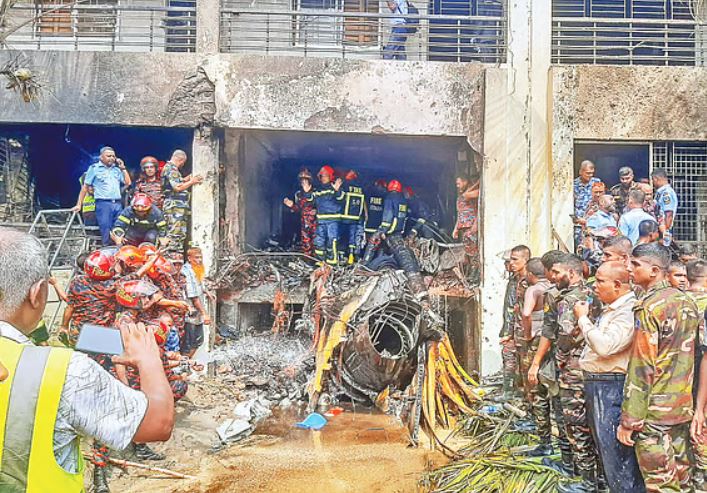
A devastating incident unfolded as a plane tragically crashed into a school during dismissal time, resulting in the loss of 34 lives, many of whom were children. The crash struck during a moment of ordinary routine when some students had just left, while others were attending post-class coaching sessions. Amid the chaos, at least 171 people sustained injuries and are now receiving treatment in eight hospitals. This heartbreaking event has left the community mourning and raised critical concerns regarding safety protocols.
The usual bustling atmosphere at Milestone School and College in Uttara turned into chaos yesterday just after 1 PM, when a devastating incident disrupted the daily routine. Students were either attending classes or preparing to head home after school when a sudden, deafening explosion tore apart the calm. Within moments, the peaceful day spiraled into chaos as flames, smoke, and panicked cries filled the school grounds.
It was later revealed that a Chinese FT-7 BGI fighter aircraft, typically used for training by the Air Force, had crashed into a two-story school building on the campus due to mechanical failure. According to the Inter-Services Public Relations (ISPR), the aircraft departed from the Kurmitola Air Force Base at 1:06 PM and crashed into the school building at 1:18 PM. Knowledge of the crash reached Fire Service and Civil Defense shortly thereafter.
A Tragic Chain Reaction
Once the plane collided with the school, a chain reaction of tragedy followed. The building was immediately engulfed in flames, creating an environment of chaos as parents frantically searched for their children. The painful cries of injured students, combined with the anguish of families searching amidst the destruction, painted a grim picture of despair. By 1 AM that night, the official death toll had risen to at least 34 individuals, with an additional 171 reported as injured. Most of the casualties were children.
Eyewitness accounts indicate that the crash occurred just as students were leaving after school had ended, with some attending coaching classes in the building. The structure impacted by the crash housed classrooms for younger students, including third and fourth grades. Sadly, many children playing near swings outside the building at the time of the crash were caught in the explosion’s aftermath.
First Responders Arrive
The crash site was a scene of utter devastation. Emergency responders, including fire services, police, armed forces, and volunteers, rushed to the area to begin rescue operations immediately. Unfortunately, many victims succumbed to their injuries even before they could be transported to local hospitals. The pilot of the aircraft, Flight Lieutenant Tauquir Islam, managed to eject before the crash but was found dead at the scene. Reports confirmed that the crash resulted from mechanical failure, which rendered the pilot unable to steer the plane to a safer location.
Victims were transported to various hospitals, including Dhaka Medical College, the National Institute of Burn and Plastic Surgery, and several private hospitals in Uttara. Witnesses noted the emotional scene at the hospitals as relatives searched frantically for information. The severity of the incident overwhelmed hospitals, with medical teams working around the clock to tend to the injured. Several survivors were admitted with severe burns, leaving them in critical condition.
Rescue Operations Encounter Challenges
Rescue efforts were complicated by the location of the crash. The Milestone School and College, situated near a densely populated area, made it difficult for first responders to carry out operations efficiently. Access roads to the site were quickly blocked by bystanders, adding delays to the already time-sensitive task of extracting survivors. Bystanders and student volunteers assisted wherever possible by carrying water and essential supplies for rescuers.
Despite the challenging conditions, fire service crews worked tirelessly until late into the evening to ensure all individuals were accounted for. By 8 PM, the immediate rescue operation had concluded, though a unit remained on site to oversee the removal of the aircraft debris.
Causes and Investigations
Following the incident, ISPR released an initial report providing insight into the cause of the crash. According to officials, the FT-7 BGI aircraft encountered technical difficulties shortly after takeoff from Kurmitola Air Force Base. The pilot had reportedly attempted to maneuver the jet away from populated areas but was unable to prevent it from crashing into the school building.
The crash raises questions about the safety of this particular model of aircraft. The FT-7 BGI is a variant of older Chinese aircraft that has been involved in other accidents. Notably, a similar aircraft crashed during an Air Force training exercise in November 2018 in Tangail, claiming the life of Wing Commander Arif Ahmed Dipu. Another FT-7 variant crashed off the coast of Chattogram in 2021, resulting in the death of Flight Lieutenant Tahmid. Following the latest incident, a high-level inquiry has been launched to ascertain the factors contributing to the crash and to evaluate whether operational safety standards were adequately met.
Mourning and Reflection
The sheer scale of the tragedy cast a shadow over the nation. Government officials, including the interim Chief Adviser Professor Muhammad Yunus, expressed their deepest condolences for the lives lost. A day of national mourning was declared, during which flags were flown at half-mast as a mark of respect for the victims. Political parties, civic groups, and citizens extended their sympathies and demanded thorough investigations to prevent similar accidents in the future.
Both government and private hospitals assured the public that they would provide free medical treatment to all injured individuals. The Ministry of Health issued directives to extend comprehensive care to the victims, while the administration pledged support to the affected families. However, questions remain about compensation and long-term assistance for those who lost loved ones or sustained life-altering injuries in the tragedy.
The Human Cost of the Incident
The sorrow in the aftermath of the crash was palpable. Families continued to gather in hospital corridors, hoping for updates on their loved ones. Reports indicated that some parents recognized their children’s bodies only after DNA tests, as the intensity of the fire left several victims unrecognizable.
One father recounted arriving at the scene within minutes of the crash, only to find bodies scattered across the ground and widespread devastation. Survivors described the moments before the crash, with students running for safety, and flames spreading rapidly through the building. Teachers shared their experiences of attempting to lead children to safety, with one describing how she used water from a restroom to douse flames engulfing several students.
Honoring the Victims
Efforts have already begun to honor the victims and provide support for their families. Community members, advocacy groups, and volunteers have called for greater safety protocols near schools and populated areas. Educational institutions observed moments of silence, and memorial services are being planned in the coming days to pay tribute to those who lost their lives.
Amidst this tragedy, the bravery and resilience of the community have stood out. Volunteers stepped forward to donate blood for the injured, while neighbors brought food and supplies to assist responders at the crash site.
Preventing Future Tragedies
This incident has highlighted the urgent need for reevaluating safety measures around urban areas, particularly those near aviation training zones. Experts stress the importance of inspecting and maintaining older aircraft models, as mechanical failures in densely populated areas pose catastrophic risks. Additionally, there are calls to restrict air force training operations near schools and hospitals to ensure civilian safety.
Looking Ahead
The crash at Uttara’s Milestone School underscores the devastating impact of accidents involving aviation training exercises and brings into focus the need for comprehensive safety measures to protect civilian lives. While investigations will undoubtedly yield critical findings, efforts must prioritize the well-being of survivors and the families most affected by this tragedy. The days ahead will be critical for addressing these concerns and ensuring that meaningful steps are taken to prevent such incidents in the future.