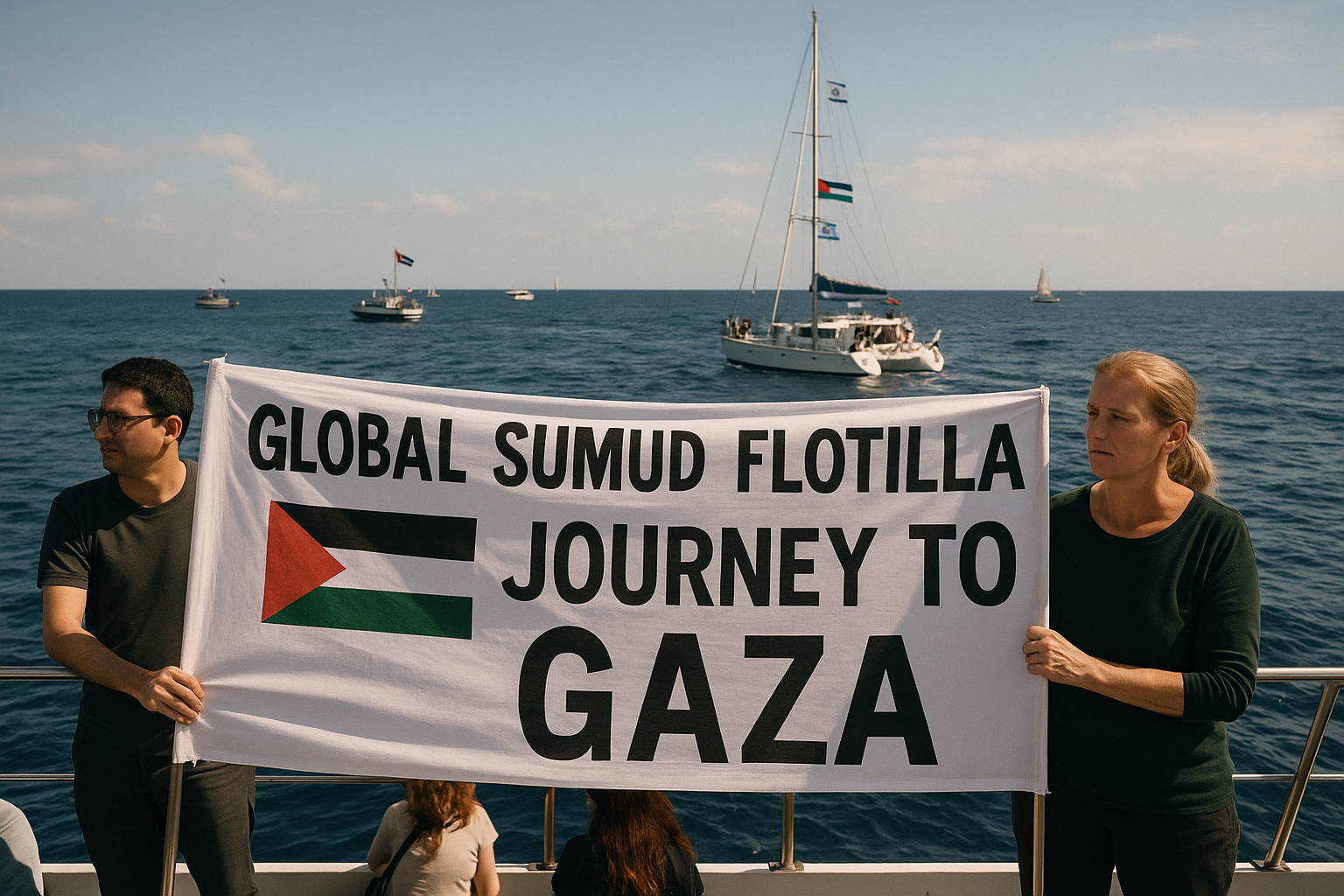
In late summer and early autumn of 2025, a civilian armada calling itself the Global Sumud Flotilla (GSF)—“sumud” meaning steadfastness—left Mediterranean ports with an ambitious mission: sail humanitarian aid to Gaza, challenge Israel’s long-standing naval blockade, and force the world to confront the war’s human cost. Organizers framed the voyage as a nonviolent action to open a maritime humanitarian corridor; Israel vowed to stop the boats, citing security, active hostilities, and long-standing policy. As the vessels drew closer to Gaza’s coast, the question was not if there would be a confrontation, but how, where, and with what consequences.
Prologue: A convoy sets to sea—and into a legal and political storm
On October 2, 2025, Israeli naval forces intercepted the flotilla in international waters, detaining hundreds of activists and escorting the boats to Israeli ports for processing and deportation. Reports differed on whether any vessel actually reached Gaza’s territorial waters; organizers claimed at least one boat briefly did, while Israeli military channels denied it. Either way, the operation jolted global politics and reignited a polarized debate about the blockade’s legality, proportionality, and humanitarian effect.
How the flotilla came together
The Global Sumud Flotilla emerged from a coalition that included the Freedom Flotilla Coalition (FFC)—active since 2010—and regional groupings such as Sumud Nusantara (Southeast Asia), among others. The project’s central claim was straightforward but provocative: that the Gaza blockade is unlawful collective punishment, and that civil society has a right—and duty—to breach it in order to deliver aid. Organizers stitched together boats, skippers, crews, satellite trackers, and a decentralized media operation designed to livestream encounters at sea and keep the story visible even if communications were jammed.
GSF’s public-facing site and partner announcements set out the goals—sail, deliver, and symbolically puncture the sense of inevitability around the maritime siege. They cast the flotilla within a lineage of seaborne challenges, from the Free Gaza Movement missions of 2008 to the Mavi Marmara flotilla in 2010.
The route: Mediterranean waypoints and a tightening perimeter
Through September 2025, flotilla vessels marshaled at ports in Spain and Italy and moved in stages across the Aegean, pausing around Crete and Koufonisi as sea states, logistics, and legal notices shifted. Photos and dispatches chronicled a rolling caravan at anchorages south of Crete—one part nautical choreography, one part media theater. Israel-based reporting openly debated tactical options for stopping the convoy without overreach that could generate sympathetic headlines for the activists.
As the flotilla advanced, Israeli media and security commentators spoke of preparations by the Shayetet 13 naval commando unit—Israel’s maritime special forces—to conduct interdictions at sea. Human-rights maritime monitors tracked the convoy and warned of imminent interception. The flotilla’s social channels, meanwhile, highlighted a diverse passenger list: parliamentarians, lawyers, NGO personnel, clergy, mariners, and high-profile activists.
The flashpoint: Interception on October 2, 2025
Where and how the stop occurred: Multiple outlets report that Israeli naval craft intercepted the flotilla roughly 70–80 nautical miles from Gaza—well beyond territorial waters—and boarded vessels after radio warnings to alter course. Organizers and onboard streamers posted live feeds until communications were cut. Israeli authorities transferred detainees to Ashdod and onward for processing and deportation; aid cargoes were offloaded and inspected.
How many boats and people: Accounts converge on a large convoy—more than 40 boats and roughly 450–500 participants. Israel’s account emphasizes enforcement against an unlawful attempt to enter a declared combat zone; flotilla communications stress the mission’s civilian character and humanitarian intent. AP News+1
Did any ship reach Gaza waters? Here the record is contested. Newsweek cited tracker data suggesting the vessel Mikeno briefly entered the zone around Gaza; the Guardian likewise relayed claims that one boat may have “got through,” while also noting Israeli statements that no ship breached the blockade. Later the Sumud Nusantara Command Centre said only Marinette remained at sea heading toward Gaza as others were detained. In short: at least one “breakaway” boat appears to have approached Gaza’s waters, but Israel says none arrived.
Who was on board: Reports list European lawmakers, legal observers, mariners, clergy, and prominent activists; several outlets said Greta Thunberg was among those detained. National governments (e.g., South Africa) publicly intervened on behalf of their nationals and denounced the seizure.
International reactions: Within hours, condemnations and diplomatic protests issued from capitals across Europe, Latin America, and Asia, with some states linking the interception to broader allegations about the blockade’s lawfulness and compliance with International Court of Justice (ICJ) provisional measures in South Africa v. Israel. (The ICJ ordered measures in January 2024, including obligations to enable humanitarian assistance—orders that different actors interpret in sharply divergent ways.)
The law of the sea and the law of blockade: where arguments clash
The core legal dispute turns on whether Israel’s naval blockade of Gaza—announced and enforced long before the current war—remains lawful and on whether humanitarian necessity alters the calculus.
-
Israel’s position has long leaned on the 2011 UN Secretary-General’s Panel of Inquiry (the “Palmer Report”), which concluded the naval blockade, as a matter of law, could be lawful as a measure in an armed conflict to prevent weapons smuggling, even as it criticized excessive force in the 2010 raid. Israel argues that, amid active hostilities, stopping the flotilla in international waters to prevent a breach was permissible under the law of naval warfare.
-
Organizers and many critics counter that the blockade, in practice, functions as collective punishment incompatible with humanitarian law, especially given the scale of civilian harm in Gaza since the 2023–2025 war. They cite UN General Assembly resolutions calling for an end to the blockade and ICJ provisional measures requiring Israel to enable humanitarian aid—arguing that civil society, faced with governmental paralysis, is justified in attempting to deliver relief by sea.
-
2010 vs. 2025: Legally, the 2011 Palmer findings predate the current war and subsequent ICJ orders by more than a decade. Some international lawyers contend that even if a blockade can be lawful in principle, proportionality and humanitarian access requirements may be breached in fact given the current scale of need. Others maintain that only states, not private flotillas, can create or lawfully breach blockades, and that humanitarian cargo should flow through agreed channels (ports under inspection, UN corridors), not by forcible challenge at sea. The law here is both technical and politically charged—leaving plenty of space for competing narratives. (For historical/legal context see Palmer, the UN HRC fact-finding report on the 2010 raid, and subsequent scholarly debate.)
The humanitarian frame
Whatever one’s legal conclusion, the humanitarian argument has been front and center. By mid-2025, UN relief officials warned the Security Council of the erosion of the rules of war in Gaza and pleaded for unhindered, scaled aid access by land, air, and sea. The UN General Assembly vote in June 2025 demanded the blockade’s end and the opening of all crossings; flotilla organizers cited such statements to justify civil intervention. Israel and some allies respond that aid must be inspected and routed through controlled corridors to prevent diversion to armed groups.
Media, messaging, and the “politics of the image”
The flotilla’s strategy hinged on visibility: livestreams from decks, GPS trackers, and a press corps primed to share each turning point. Organizers knew that even an inevitable interception could become a narrative win if the images showed civilian boats confronted by warships. Israeli planners, remembering the 2010 Mavi Marmara fallout, sought a careful intercept—firm but calibrated to minimize injury and avoid a spiraling PR disaster. As one Israel-based analysis put it days before the stop, the government weighed options from persuasion to tightly choreographed interdiction—anything to prevent images that would dominate global screens.
On October 2, each side raced to frame the encounter: activists emphasized peaceful intent and alleged rough tactics; Israel highlighted security and claimed a smooth operation conducted in international waters. Contradictory claims about the Mikeno and the status of Marinette underscored how open-source tracking, official communiqués, and onboard video each carried evidentiary weight—but not always in the same direction.
Diplomatic aftershocks
The stop triggered swift diplomatic responses. South Africa demanded the release of its nationals, including Mandla Mandela; other governments summoned Israeli envoys or issued condemnations; protests erupted in cities across Europe and Latin America. Some leaders linked the interdiction to broader critiques of international paralysis at the Security Council. Israel’s government, for its part, praised the navy, accused the flotilla of a “delegitimization campaign,” and emphasized that aid can and should go through established channels.
What “success” means—when the plan is to be stopped
The paradox of flotilla politics is that interception can be part of the plan. For organizers, getting this far—assembling a multinational convoy, drawing escorts and headlines, and forcing officials to justify the blockade anew—constitutes a kind of success. Even if cargo never touches a Gazan pier, the voyage reframes the conversation around humanitarian access and the lawfulness of the siege. For Israel, stopping the convoy without loss of life is also success: a demonstration that maritime control remains intact, with security prioritized and precedent maintained. Both sides speak to different constituencies: activists to global civil society and sympathetic governments; Israel to domestic audiences and security partners.
Comparisons to 2010—and what’s changed
The 2010 Mavi Marmara raid ended in lethal violence and a diplomatic rift with Turkey. The 2011 UN panel later assessed the blockade as lawful while criticizing excessive force. In 2025, with a larger war as context, the legal, political, and moral stakes are higher. The ICJ’s provisional measures and UNGA actions add layers that didn’t exist in 2010, and the humanitarian emergency is more acute by nearly every metric. Israel has adapted tactics to avoid deadly escalation at sea; activists have adapted media strategies to sustain pressure even without docking in Gaza.
The contested facts: how to read today’s diverging reports
Three practical points help readers evaluate claims that one boat “broke through”:
-
Definitions matter: “Reached Gaza’s waters” could mean entered the 12-nautical-mile territorial sea, approached it, or was escorted at the line.
-
Sources differ: Tracker data can lag, misplot, or be spoofed; military statements are precise but selective; onboard video shows only a slice.
-
The status of stragglers: As of October 3, some sources said Marinette was still sailing after others were stopped; Israeli outlets insisted no breach occurred. Until official logs and independent investigations surface, this point likely remains contested.
What comes next: legal processes, future sails, and the wider war
-
Legal follow-ups: Expect litigation and complaints in multiple jurisdictions (wrongful detention, use of force, confiscation of cargo). Human-rights groups will likely test the intercepts against law-of-blockade standards and ICJ measures on humanitarian access.
-
More boats? Organizers had already announced “next waves” of civilian vessels from Catania and beyond, suggesting GSF is a campaign, not a one-off. Whether those departures proceed will depend on diplomatic headwinds, arrests, and funding.
-
Policy pressure: The UN and key capitals face renewed calls either to broker a maritime aid corridor or to tighten inspections while scaling aid by land. Each option runs into hard problems: security vetting, port capacity, and the risk of normalization of siege conditions.
-
Narrative war: Even absent a pier in Gaza, flotilla imagery will circulate for months—showing either courageous civil society facing down warships or reckless provocation during wartime, depending on the viewer’s priors. That’s by design.
Bottom line
The Global Sumud Flotilla has already achieved what movements of civil disobedience aim to do: force a choice. Do states tolerate—or even facilitate—civilian ships delivering aid by sea in a war zone, or do they enforce a blockade that international bodies increasingly urge to end? Israel chose enforcement on October 2, in international waters, with mass detentions and without a major at-sea casualty event—a tactical success on its own terms. Organizers chose visibility, solidarity, and confrontation with the blockade itself—what they see as the only way to shake a paralyzed international system. Whichever side one finds more persuasive, the flotilla restored a simple, searing question to the front page: How should humanitarian law work at sea when a besieged population is starving on land?