India and Pakistan share a complex and tumultuous history of conflict, which spans multiple wars, territorial disputes, and political friction. From the first India-Pakistan war in 1947 to the recent tensions in 2025, the relationship between these two nations has been defined by repeated military confrontations, most notably over the region of Kashmir. This article will explore the major wars fought between India and Pakistan, providing historical context, a detailed analysis of key conflicts, and a look at the current situation, including the potential for a new war in May 2025.
India-Pakistan Conflict 2025
The origins of India and Pakistan’s conflict lie in the partition of British India in 1947. This partition created two new nations: India, a secular, democratic state, and Pakistan, which was created as a homeland for Muslims. The partition was marked by widespread violence, mass migrations, and a deep sense of animosity between the two communities that had coexisted for centuries.
The most contentious issue from the outset was the region of Kashmir, a princely state that had a Muslim-majority population but was ruled by a Hindu king. The accession of Kashmir to India in 1947 triggered the first war between the two nations, setting the stage for a series of conflicts that would define their relationship in the decades to come.
On May 7, 2025, India launched a series of missile strikes on nine locations across Pakistan and Pakistan-administered Kashmir, marking a significant escalation in the longstanding India-Pakistan conflict. Codenamed “Operation Sindoor,” these strikes were in retaliation for a deadly attack on Hindu tourists in Pahalgam, Indian-administered Kashmir, on April 22, which resulted in 26 fatalities.
Targets of the Indian Strikes
The Indian military claimed that the targets were terrorist infrastructure linked to groups such as Lashkar-e-Taiba (LeT) and Jaish-e-Mohammed (JeM). The nine locations struck included:
-
Bahawalpur – A hub for JeM, led by Masood Azhar.
-
Muridke – Associated with LeT, founded by Hafiz Saeed.
-
Bhimber – A site in Pakistan-administered Kashmir.
-
Kotli – Another location in Pakistan-administered Kashmir.
-
Muzaffarabad – The capital of Pakistan-administered Kashmir.
-
Sialkot – A city in Pakistani Punjab.
-
Chak Amru – A village in Pakistan-administered Kashmir.
-
Bagh – A district in Pakistan-administered Kashmir.
-
Gulpur – A town in Pakistan-administered Kashmir.
The Indian Air Force utilized Rafale jets armed with SCALP cruise missiles and AASM Hammer bombs to execute the strikes, which lasted approximately 23 minutes.
Casualties and Damage
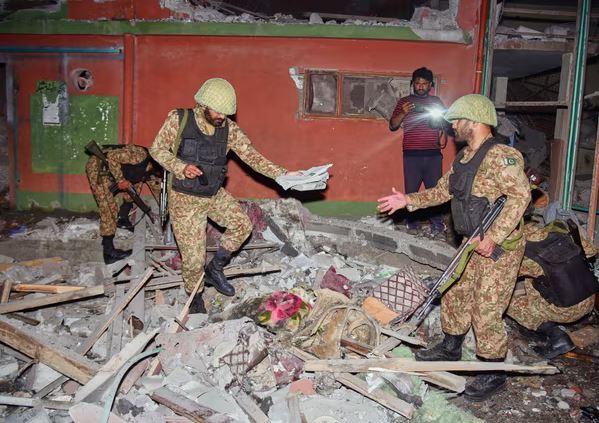
Pakistan reported at least 26 civilian deaths and 46 injuries, including women and children, due to the airstrikes. The strikes caused significant damage to civilian infrastructure, including mosques and educational institutions. In response, Pakistan claimed to have downed five Indian fighter jets and engaged in artillery shelling along the Line of Control (LoC), resulting in additional casualties.
International Reactions
The international community expressed grave concern over the escalation. The United Nations, United States, China, Russia, Turkey, and the European Union called for immediate de-escalation and dialogue between the two nuclear-armed nations. Flights across South and Central Asia were rerouted or canceled due to security concerns. Public safety drills were initiated in India, and residents in border areas took shelter in bunkers.
Context and Background
The conflict between India and Pakistan has its roots in the 1947 partition of British India, leading to the creation of two separate nations. The Kashmir region has been a focal point of contention, with both countries claiming it in full but administering parts of it. The 2025 escalation follows a series of incidents, including the 2019 Pulwama attack and the revocation of Article 370 by India in 2019, which removed the special status of Jammu and Kashmir.
Outlook
While both nations have nuclear capabilities, analysts suggest that the risk of full-scale war remains low due to the deterrent effect of nuclear weapons. However, the situation remains volatile, and the potential for further escalation exists if diplomatic efforts fail to yield results.
The international community continues to monitor the situation closely, urging both India and Pakistan to engage in dialogue to prevent further violence and to seek a peaceful resolution to the Kashmir dispute.
The First India-Pakistan War (1947-1948)
The first major conflict between India and Pakistan, often referred to as the India-Pakistan war of 1947, was triggered by the dispute over Kashmir. Following partition, Kashmir’s ruler, Maharaja Hari Singh, chose to accede to India, a decision that led to the invasion of Kashmir by Pakistani tribesmen. In response, India sent its troops to defend the region. The war lasted for over a year and ended in 1948 with a ceasefire brokered by the United Nations, which resulted in the division of Kashmir into Indian-administered and Pakistani-administered regions. This division remains a core issue between the two countries, leading to subsequent conflicts and diplomatic standoffs.
The Indo-Pakistani War of 1965
The 1965 war between India and Pakistan was primarily fought over the Kashmir region. The conflict was sparked when Pakistani forces infiltrated the Indian-administered region of Kashmir, prompting India to retaliate with military action. The war saw intense fighting, particularly in the Kashmir sector, and lasted for around two weeks before both countries agreed to a ceasefire under the mediation of the United Nations.
The 1965 war, although relatively brief, left a significant impact on both countries. Pakistan, despite initial successes, was unable to hold on to the territories it had captured, and India, though it managed to repel the invasion, did not gain any significant territorial advantage. The war ended in a stalemate, and the Tashkent Agreement was signed in 1966, which reaffirmed the pre-war positions of both sides. However, the conflict did not resolve the underlying issue of Kashmir, and tensions continued to simmer.
The India-China War of 1962
Although not directly related to Pakistan, the India-China war of 1962 had significant implications for India’s military strategy and its subsequent conflicts with Pakistan. In 1962, India fought a brief but intense war with China over the border dispute in the eastern Himalayas. The war ended in a humiliating defeat for India, and the experience of the loss influenced India’s approach to its military preparedness in the years that followed.
One of the key consequences of the 1962 war was that it prompted India to bolster its military capabilities, particularly in the context of its border with Pakistan. The war also had long-term effects on India’s national security policy, leading to a more cautious approach toward future confrontations with Pakistan.
The Indo-Pakistani War of 1971
The Indo-Pakistani war of 1971 was a watershed moment in the history of the subcontinent. This war, often referred to as the Bangladesh Liberation War, was sparked by the Pakistani military’s brutal crackdown on Bengali nationalists in East Pakistan (now Bangladesh). The Indian government, led by Prime Minister Indira Gandhi, decided to intervene in support of the Bengali independence movement.
The war lasted for two weeks, from December 3 to December 16, 1971, and ended in a decisive Indian victory. India’s military crushed Pakistani forces in East Pakistan, leading to the creation of the independent state of Bangladesh. The war also had significant geopolitical consequences, as it cemented India’s regional dominance and humiliated Pakistan, which had to surrender nearly 90,000 soldiers.
The 1971 war marked a shift in the balance of power in South Asia and left Pakistan deeply scarred, both politically and militarily. The victory solidified India’s position as a major regional power and solidified the animosity between the two nations.
The Kargil War of 1999
The Kargil War of 1999 was another key conflict in the history of India-Pakistan relations. The war was fought in the Kargil district of Indian-administered Jammu and Kashmir, where Pakistani soldiers, disguised as militants, infiltrated Indian territory and captured strategic heights. India responded with a military offensive to reclaim the territory.
The war lasted for several months, from May to July 1999, and ended in a victory for India. However, the conflict was significant because it was the first time in over 50 years that India and Pakistan fought a war with nuclear weapons in their arsenals. The war was also noteworthy for the international diplomatic intervention, particularly from the United States, which played a key role in pressuring Pakistan to withdraw its forces.
The Kargil War was a stark reminder of the volatility of the India-Pakistan relationship, and it further entrenched the security concerns of both nations, particularly regarding the issue of Kashmir. The conflict demonstrated the potential for nuclear escalation in the region, and it remains a pivotal moment in the history of Indo-Pakistani relations.
The Role of International Powers
The India-Pakistan conflict has not only shaped the two nations but also influenced the broader geopolitical landscape of South Asia. Both countries are nuclear powers, and their rivalry has had profound implications for global security. The United States, China, and other world powers have often played key roles in mediating or exacerbating tensions in the region.
The United States has historically been an ally of Pakistan, while India has cultivated closer ties with the West, particularly after the Cold War. However, both countries have also sought to diversify their international relationships. In recent years, China’s growing influence in Pakistan and the increasing military cooperation between India and the United States have added a new layer of complexity to the situation.
The international community, particularly the United Nations, has long called for a peaceful resolution to the Kashmir issue and has urged both countries to avoid military escalation. However, the deeply entrenched animosity and nationalist sentiments in both countries make it difficult for diplomatic solutions to succeed.
Conclusion: The Road Ahead for India and Pakistan
The history of India and Pakistan’s wars is a testament to the deep-rooted animosity and unresolved territorial disputes that have shaped the relationship between these two nations. From the 1947 India-Pakistan war to the 1971 Indo-Pakistani war and the Kargil War of 1999, the conflicts have been marked by military confrontations, political intrigue, and profound consequences for both countries.
As tensions rise once again in May 2025, the world watches closely to see whether a full-scale war will erupt or whether diplomacy will once again prevail. While both countries continue to maintain large military forces and nuclear arsenals, the fear of a catastrophic conflict remains ever-present. The future of India and Pakistan’s relationship will depend on how both nations navigate their differences, both on the battlefield and at the negotiating table.
In the end, the history of India and Pakistan wars serves as a powerful reminder of the fragility of peace in a region where the stakes have always been high.