

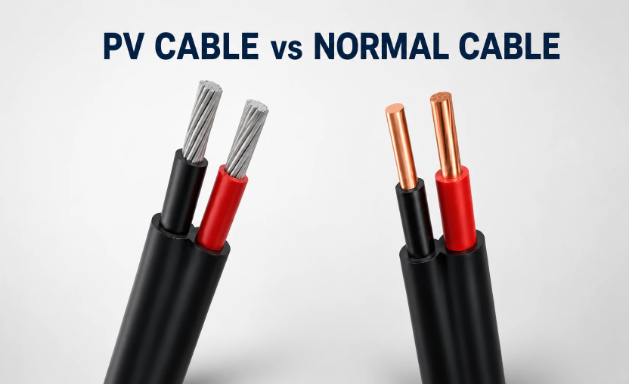
PV cable and normal cable differ on four fronts that matter for solar projects. Insulation chemistry, conductor treatment, voltage ceiling, and the certifications required by the project’s electrical code separate them. Mixing the two leads to code rejection, accelerated failure, and warranty. Anyone writing the bill of materials for a utility or commercial array has to settle the question before tenders close.
Where the Two Cables Diverge
Normal cable, including THHN and PVC-insulated building wire, was designed for indoor circuits inside conduit or wall cavities where temperatures stay stable, and the conductor never sees sunlight.
PV cable carries DC between solar modules, combiner boxes, and inverters under continuous outdoor exposure.
Insulation Chemistry
PV cable uses cross-linked polyethylene (XLPE) or cross-linked polyolefin (XLPO). Cross-linking gives the polymer a thermoset structure that does not soften above 90°C and resists UV, ozone, and moisture for decades. Normal building wire usually uses PVC, a thermoplastic that becomes brittle under continuous UV exposure and carries no sunlight-resistant rating by default.
Conductor Treatment
The conductor side shows a parallel split. PV cable uses tinned copper, fine-stranded so it flexes during rooftop routing and resists oxidation inside MC4 connectors that sit exposed for the system’s full service life. Normal building wire usually uses bare copper, solid or coarse-stranded, which oxidizes at termination points once humidity reaches it.
Side-by-Side Specifications
|
Parameter |
PV Cable |
Normal Cable (THHN / PVC) |
|
Insulation |
XLPE / XLPO (thermoset) |
PVC (thermoplastic) |
|
Voltage Rating |
600V to 2000V DC |
600V AC |
|
Temperature Rating |
-40°C to +90°C, peak 120–150°C |
90°C dry / 75°C wet |
|
Sunlight / UV Listing |
Required |
Not provided by default |
|
Direct Burial |
Yes |
No |
|
Outdoor Service Life |
25 years (TÜV / UL listed) |
5 to 10 years |
|
Common Certifications |
UL 4703, EN 50618, IEC 62930, TÜV |
UL 83, UL 44 |
|
Conductor |
Tinned, fine-stranded copper |
Bare copper, solid or stranded |
Normal cable, capped at 600V AC, cannot match either the voltage class or the wet-rated UV durability that PV circuits require. The 2000V DC ceiling permitted under the latest UL 4703 standard is a direct response to higher string voltages used in modern utility arrays.
Standards That Separate the Two
In the United States, NFPA 70, the National Electrical Code, governs PV system wiring through Article 690 and requires DC source and output circuit conductors to be listed for PV use. That means UL 4703 PV wire or USE-2 should be used. THHN, NM-B, and similar normal cables do not carry that listing and cannot be substituted, even in temporary installations.
Europe enforces the same boundary through EN 50618 for H1Z2Z2-K solar cable, and the international harmonized version is IEC 62930. Cables built to these standards, such as the PV1-F 1500V DC type, carry the tinned conductor and XLPO insulation the standard requires. Normal cable does not, regardless of how well it performs on AC circuits indoors.
Voltage Caps Built Into the Code
The 2023 NEC limits PV system DC circuits to 600V on one- and two-family dwellings, 1000V on other building-attached arrays, and allows 1000V to 1500V DC on ground-mounted systems under Section 690.31(G). Each tier requires a cable rated to or above the string’s open-circuit voltage, which only the listed PV cable provides.
Why the Difference Matters Over the System Life
The economic gap between the two cables widens as the array ages. According to the IEA Global Energy Review 2026, the world added 605 GW of new PV capacity in 2025, lifting cumulative installed capacity to roughly 2.8 TW. At that scale, choosing the wrong cable family is a fleet-level problem, not a per-project one.
A TÜV or UL-listed photovoltaic cable holds its dielectric and mechanical properties through the panel’s full 25-year warranty term. PVC building wire in the same environment usually requires replacement once or twice in that window, with rooftop labor and reinspection added each time.
Capital saved at procurement on cheaper cable is generally offset by the first unplanned replacement cycle, which is why specifiers treat the choice between PV cable and standard building wire as a long-term cost decision rather than a unit price one.
FAQ
Can I substitute THHN wire for PV cable in a solar array?
No. THHN lacks the UV and wet location ratings required by NEC Article 690 and UL 4703. Only listed PV wire or USE-2 may be used in exposed DC PV circuits.
What is the practical difference between XLPE and PVC insulation?
XLPE is a thermoset polymer that does not soften above 90°C and resists UV and ozone. PVC is a thermoplastic that becomes brittle under sunlight and is not rated for outdoor PV use.
Why does PV cable use tinned copper rather than bare copper?
Tin plating slows copper oxidation inside MC4 connectors that sit outdoors for decades. Bare copper develops a high-resistance oxide layer that drives connection losses upward over the service life.
Does a 1500V DC system reduce cable cost compared with 1000V DC?
Yes. Higher string voltage cuts current for the same power output, allowing smaller cross-sections and less copper per MW. The cable must still be rated to or above the string’s open-circuit voltage.
What cable belongs on the AC side of the inverter?
AC output conductors run on standard power cable listed for the relevant voltage class. PV cable is only required on the DC side between the modules and the inverter.
Summary
PV cable and normal cable look similar on paper, but their materials, ratings, and certifications place them in different code categories. XLPE versus PVC, tinned versus bare copper, DC versus AC voltage class, and UL 4703 versus UL 83 are the distinctions that decide whether a cable belongs in a solar circuit. For any DC run that will sit under direct sun for 25 years, only the listed PV cable meets the code, the standard, and the service life the project bid is built around.